
📊 Breaking down record deal scenarios in google sheets
Enter the sandbox

Reminder! Infinite Catalog is (a) royalty accounting software; (b) a company of cool nerds who will help you get royalties done; and (c) currently running the January Special 🎉 (last chance!). Sign up free today.
As we near the end of January, I wanted to do another back-to-basics post that will hopefully be of interest to new and experienced record labels alike. It’s on my all time favorite music industry subject: the profit share label deal.
Here’s a video version of the whole post - if you find these videos helpful, let me know in some way (subscribing will do) and I’ll continue to do them and perhaps up the production value a bit.
Often referred to as “50/50 deals” (the most common version), profit share deals are easy to understand, easy to adapt to different situations, and easy to stay on top of (accounting-wise at least; tracking income from all the sources can be a beast).
Profit share deals are also inherently transparent. Unlike major label-style “royalty base deals,” which we don’t have time to get into but you can read all about here, with profit share deals it’s possible to know what the label also earned (or lost), which builds trust for the long run and leads to many more “successful” deals.
(Success, in this middle child’s opinion, being one in which no one feels like they got screwed, regardless of outcome.)
Plus, profit share deals are easy to model, and “seeing” them play out via simple sandbox versions is a great way to help folks understand how they work.
So let’s do exactly that, by running through a few simple profit share deal scenarios, sandbox style:
a simple 50/50 profit share deal w/ advance (to illustrate the basics)
a 60/40 deal where the artist is repaid for recording expenses (illustrating how profit share deals can be adjusted to help both parties)
a 50/50 deal that switches to a 90/10 distribution deal (illustrating “term lengths” and they can be used to everyone’s advantage)
Got a scenario you want to model? Copy the template + scenarios here and/or feel free to reply or comment with the situation and I’ll be happy to respond.
Lastly, for anyone completely new, to all this our free royalty statement template + guide is a good primer on the basics of profit share, including a terms glossary.
Ok! Without further ado, let’s dive into these sandboxes.
Scenario 1: basic 50/50 profit share deal w/ advance
First up, the most basic profit share deal there is, including a small advance just to show how that gets treated differently than expenses.
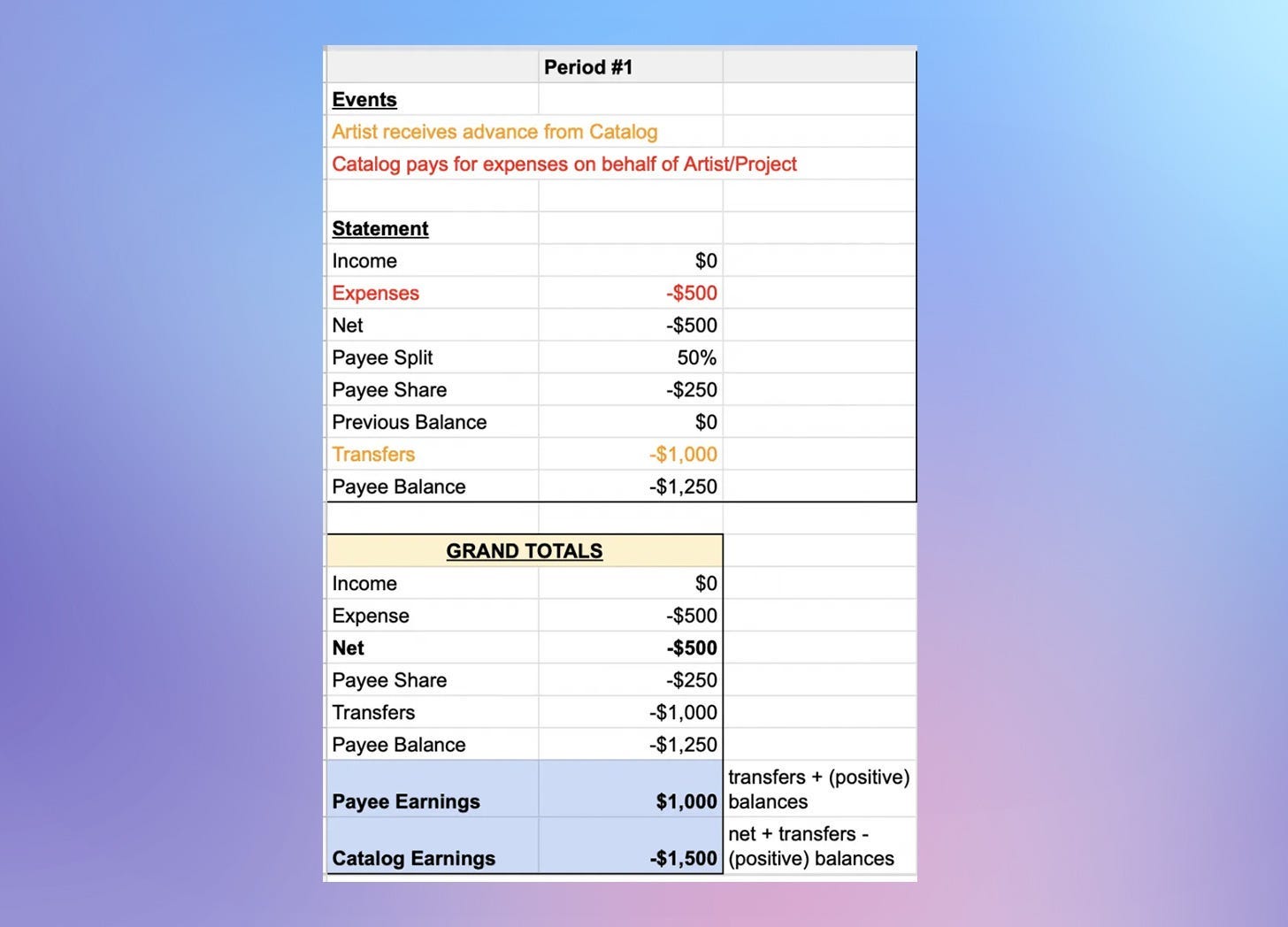
The first period shows the artist receiving a $2K advance from the label, which goes in as a negative Transfer. Transfers must be accounted after the split, because they’re direct payments between the label and the payee/artist - the payee needs to pay it back in full from their own share of the net.
There’s also $3k in Expenses, which are paid for by the label and go in before the split. These are effectively “shared” costs between the label and the payee; while the label pays them out of pocket and the artist doesn’t have to pay them back if it doesn’t recoup, the payee is still ultimately “paying” for their own share of the expenses via the net if they DO recoup.
(Major label-style deals work the same — except you’re paying for 100% of most costs out of a ~15% share of a made up $X per unit sold.)
In Period #2 we start to see Income coming through, which gets factored into the Net right alongside the Expenses. The previous balance has carried over and the payee has now recouped, resulting in a positive balance, which get’s paid and accounted in Period #3 as a Transfer, illustrating that an advance is indeed just a future payout!
Scenario 2: a 60/40 deal where artist is repaid for recording
This one isn’t a typical arrangement, but imho it’s a great illustration of how profit share deals can be adapted for mutual benefit.
Imagine that an artist has already paid $10k for their own recording costs, and wants to put it out with a label, who agree to spend $10k of their own for manufacturing and marketing and suchlike.
The label and artist are both savvy about how profit share deals work, so they come up with this arrangement: instead of the label paying the artist back upfront and then having nothing to spend, they can instead credit the artist via a $10k Transfer, AS WELL AS including that amount as a shared expense. This way it’s reflected as both an Expense to be shared (fair) and an “advance”/Transfer from the artist to the label (also true).
They and the label agree that a 60/40 deal in the artists favor is a fair way to compensate them for their initial outlay and additional risk.
The label spends the other $10k on expenses, and it works! In Period #2 they collect $20k in income, which *60% = a $12k payee share. Including the previous period balance, everyone has now broken even, both parties having spent $10k and recouped $10k.
In Period #3, they make another $20k, and now the 60/40 deal is paying off for the artist, who earns $12k to the labels $8k this period, and 60/40 until the end of the term
Scenario 3: a 50/50 deal changes to 90/10
Speaking of “terms”, which we’ve glossed over till now, we’ll end on a 50/50 record deal that switches to a 90/10 distribution deal, and use it to illustrate the concept of “term lengths.”
Every record deal has a term length, which specifies when it comes to an end. If it doesn’t have a term written down on paper, it’s known as a “handshake” agreement, and is essentially an ongoing mutual agreement that could end at any time.
Terms are typically a timeframe like 5, 10, or 20 years, or “life of copyright,” which often (though not always) means “forever.” In general, the artist wants as short a term as possible, and the label wants as long a term as possible.
“What’s fair” depends on a number of factors, but a simple way to think about it is in relation to the advance and/or amount the label agrees to spend.
Little to no advance/guaranteed spend? Short term. Medium sized? Medium term. Big money? Lengthy term.
Typically, but not always, they’re dependent on the record being recouped (meaning, if it’s still in the red after the term, the deal keeps going until it is recouped). Terms can also be based on other things, like hitting certain sales thresholds, or in the case of Jay Z, agreeing to become the president of Def Jam.
When the end of a term is reached, things don’t need to come to a screeching halt — and I’ll suggest they shouldn’t, as it creates unneeded pressure and uncertainty for both parties. Instead, you can make it so the artist can still take their masters back whenever, but in the meantime their share of the profits goes from say, 50% to 90%, morphing it from a “record deal” to a “distribution deal.”
This way, even if the artist isn’t ready or able to “take back” their record, they’re still getting a “good deal”, while the label is still getting something in exchange for continuing to distribute, account, and pay out the royalties on what has likely become a passively earning part of their overall catalog.
Ok that’s plenty for now!
Remember, you can copy the sandbox template here and/or feel free to reply or comment with the situation and I’ll be happy to respond, and our free royalty statement template + guide is a good primer on the basics of profit share, including a terms glossary.