

Kidding about James Blake1, but stop me if you’ve heard this one before: streaming services are being manipulated by outside actors to steal royalties en masse from artists and rightsholders, while the streaming services play half-hearted whack-a-mole and the wider music industry looks on.
Indeed, the most inevitable collab between lightly regulated and highly manipulatable platforms has finally dropped. Sucker markets like Kalshi and Polymarket, rife with insider trading and incentivizing the manipulation of everything, are evidently booking big business in the music prediction game: $400M on Kalshi alone from Jan-April this year, according to Kalshi COO and 29-year-old billionaire, Luana Lopes Lara.2
And it was amidst all this exciting economic activity that someone had the audacity to artificially inflate the stream count of "Earrings” by Malcolm Todd by at least 500k to help its chart position and collect a tidy sum. (To be clear, Todd is not implicated in the scam itself.)
For their part, Spotify confirmed those plays have now been removed from the royalty pool thanks to their intrepid fraud detection squad a rival bettor who flagged the suspicious behavior on X, per the FT.
This was basically inevitable. For over a decade, the pro-rata royalty model used by Spotify and most other streamers, in which royalties are paid out based on a track’s percentage of the entire royalty pool, has incentivized an entire cottage industry of streaming manipulation.
Thanks to pro-rata, anyone can attempt to setup multiple accounts to bot-farm streams and extract more royalty revenue than they’re putting in, which in turn lowers the poolshare and subsequent payout for every single other artist and rightsholder (and even, tragically, their fellow scammers).
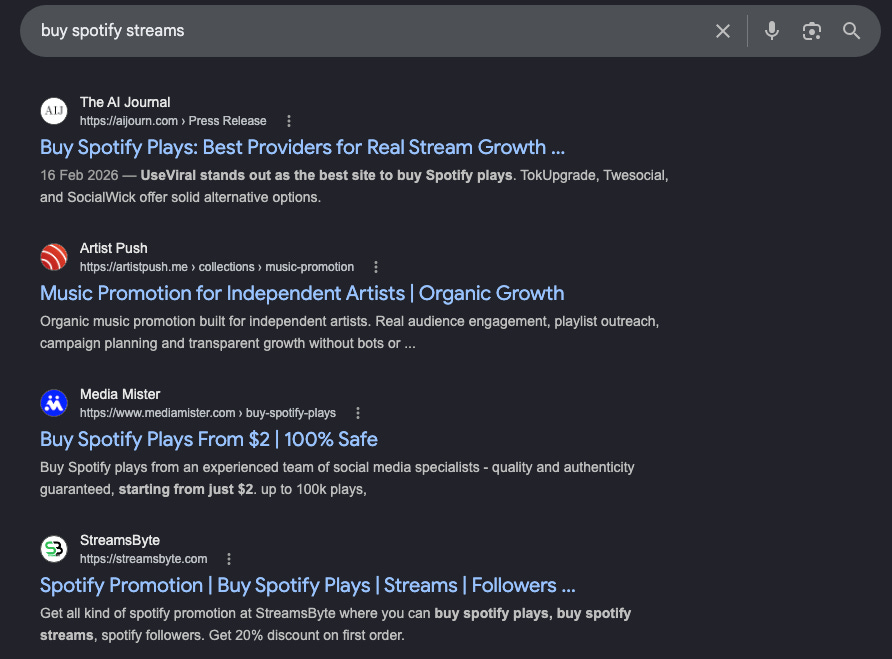
This particular scam has been cat and mousing it with Spotify and other streamers for years, and if the Kalshi news and this quick google search are any indication, it is alive and well.
Note that bot-farming streams would not be nearly as incentivized in a user-centric model, where each account funds only the music they listen to, less the platform’s cut (meaning a scammer can’t take out more than they put in). Yes, there would likely be other scams — and yes, you could bot-farm your way to No.1 and win big on Kalshi even in user-centric — but the ease, scale, and longevity of the bot-farming scam laid the groundwork for exactly this fiasco.
Streaming services have had well over a decade to make pro-rata work, and what we’ve gotten is a system that favors aging superstars at the literal expense of everyone else, while facilitating an estimated $1.1B in artist wages lost to streaming fraud per year… on Spotify alone.
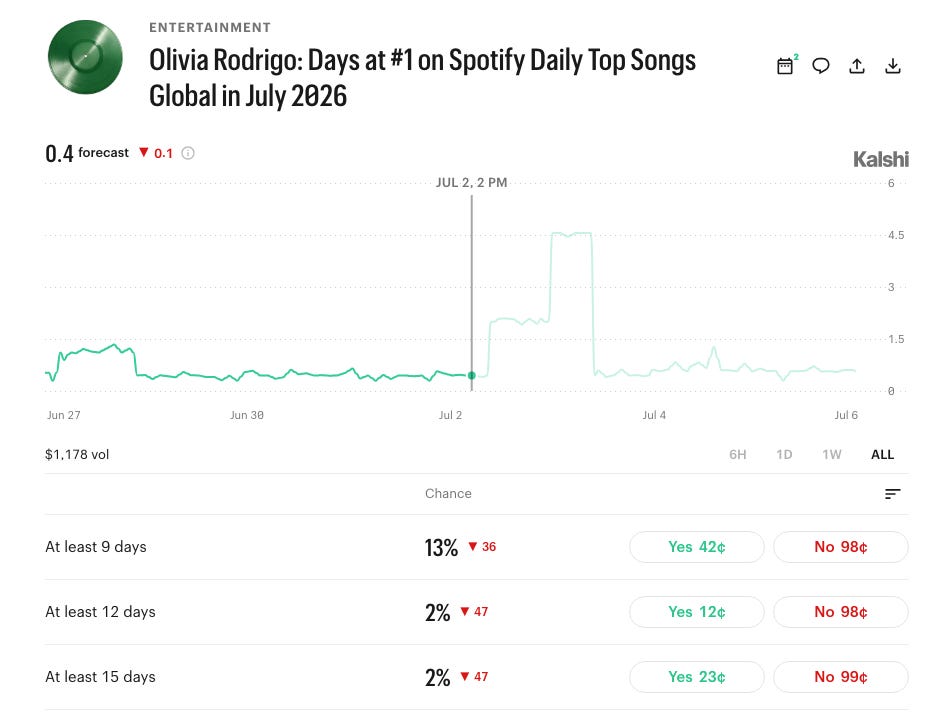
Now if you’ll excuse me, I’ve got a side hustle to attend to some Olivia Rodrigo to listen to.
Sean Adams had the best take on that imho
Here’s the quote. Ironically Luana Lopes Lara recently took the “youngest female billionaire” crown from Lucy Guo, an AI founder, who took it from… Taylor Swift. Personally, I’d bet that Taylor Swift has created vastly more joy and real economic value than the other two combined. Any takers?